If you have started phoning around for painting quotes in Johannesburg or Pretoria, you have probably already discovered the frustrating part: three contractors can look at the same house and come back with numbers that differ by 40% or more. That is not necessarily a sign that two of them are trying it on. Painting is one of those trades where the visible work — rolling paint onto a wall — is a small fraction of the actual labour, and where the invisible work underneath determines whether the job lasts three years or ten.
This guide sets out what painting actually costs in Gauteng in 2026, where the money goes, and how to read a quote properly. It is written from the contractor's side of the table, which means it includes the things that make a job more expensive as well as the things that are padding.
On this page
- The short answer
- How painting is priced in South Africa
- Current market rates per square metre
- What it costs by house size
- Interior vs exterior — and why exterior costs more
- What a proper quote must include
- The seven things that move the price
- A worked example, line by line
- Six mistakes that cost homeowners money
- How to compare three quotes properly
- Checking a contractor is legitimate
- Frequently asked questions
- Conclusion
The short answer
For a standard Gauteng home in 2026, published market rates put labour-only painting at roughly R40–R95 per square metre, and labour plus materials at roughly R100–R250 per square metre. A typical three-bedroom house usually lands somewhere between R14,000 and R30,000 depending on whether you are doing inside, outside, or both.
Key takeaways
- Painting is quoted on wall area, not floor area. A 150m² house can have 400m² of paintable surface.
- Preparation is typically 40–50% of the labour on an exterior repaint — and it is the first thing a cheap quote leaves out.
- The cheapest quote is frequently the most expensive one, because the saving comes out of prep.
- A quote worth comparing names the primer and the topcoat product, not just the brand.
- Double storey adds roughly 15–25% for access and safety setup.
How painting is priced in South Africa
Before the numbers make sense, three terms need explaining, because they are the source of most quote confusion.
Square metre pricing — and which square metres
Almost all painting in South Africa is quoted per square metre. The critical detail is that this means the area of surface being painted, not the floor area of your house. People routinely assume a 150m² house means 150m² of painting. In practice, once you count internal walls (both sides), ceilings, and the full external envelope, that same house can easily present 350–450m² of paintable surface.
This is also why a contractor who quotes over the phone without measuring is guessing. Two houses with identical floor area can differ substantially in wall area depending on layout, ceiling height and how many internal walls there are.
Labour-only vs supply-and-apply
A labour-only rate means you buy the paint and the contractor applies it. A supply-and-apply rate (sometimes "labour and materials") means the contractor supplies everything. The gap between R40–R95/m² and R100–R250/m² is almost entirely this distinction. Comparing a labour-only quote against a supply-and-apply quote is the single most common way homeowners end up confused, so establish which basis you are being quoted on before anything else.
Coats, and whether primer counts as one
A repaint specification is normally primer plus two finish coats, or on sound previously-painted walls, two finish coats with spot-priming of repairs. Some quotes describe "two coats" and count the primer as one of them. That is one finish coat, and it will not give you even colour or the expected lifespan. Ask explicitly: how many finish coats, over what primer.
How to read the numbers in this guide. These are published market ranges collected from South African quoting platforms and price guides, not regulated tariffs and not our own rates. They are here so you can sanity-check a quote you have been given. There is no official price schedule for painting in South Africa — anyone presenting one as authoritative is inventing it.
Current market rates per square metre
| Type of work | Published range (per m²) | What drives the spread |
|---|---|---|
| Interior walls | R50 – R100 | Lower end for sound walls needing two coats only |
| Exterior walls | R40 – R100 | Higher where prep, crack repair or access equipment is needed |
| Labour only | R40 – R95 | You buy the paint separately |
| Labour + materials | R100 – R250 | Contractor supplies everything; paint tier matters most |
| Roof coating | R50 – R120 | Varies sharply by roof type — see our roof guide |
| Ceilings | R45 – R90 | Access, height and whether there is staining to seal |
What it costs by house size
Per-square-metre rates are useful for checking a quote line by line, but most people want a ballpark for their actual house first. These are published figures for labour plus materials:
| Property | Interior | Exterior |
|---|---|---|
| 2-bedroom flat or townhouse | R8,000 – R16,000 | Usually body corporate |
| 3-bedroom house | R14,000 – R26,000 | R16,000 – R30,000 |
| 4-bedroom house | R20,000 – R35,000 | R24,000 – R45,000 |
| Single room repaint | R1,500 – R3,500 | — |
| Ceiling only (per room) | R500 – R1,500 | — |
Double storey adds roughly 15–25%. This is not opportunism. Working at height means scaffolding or tower access, slower movement between areas, more setup and breakdown time each day, and two people on tasks where one would otherwise do. It also carries genuine occupational health and safety obligations that a legitimate contractor is carrying insurance and training costs for.
Interior vs exterior — and why exterior costs more
Interior work is the more predictable of the two. The surfaces are protected from weather, the preparation is usually filling, sanding and priming repairs, and the schedule does not depend on conditions outside. The real labour goes into masking, floor protection, moving and covering furniture, and cutting in by hand around cornices, skirtings, door frames and light fittings. A tidy interior job is largely a job of careful protection.
Exterior work on the Highveld is a different proposition. Walls here take a specific kind of punishment. Research co-authored by the South African Weather Service found that South African sites at higher altitude experience higher mean solar UV, with Pretoria showing a mean UV index of 6 across the measurement period and levels peaking in summer.[1] That sustained ultraviolet exposure is what chalks and fades cheaper exterior coatings.
Then there is water. Johannesburg receives around 713mm of rain a year, and roughly 84% of it falls between October and March, largely as afternoon and evening convective storms.[2] Peer-reviewed hail research places the country's hail activity concentrated along the Highveld, most frequent from mid-November through February.[3] Exterior paint in Gauteng is not just weathering gradually; it is being cycled between intense UV, sudden heavy wetting, and in a bad year, physical impact.
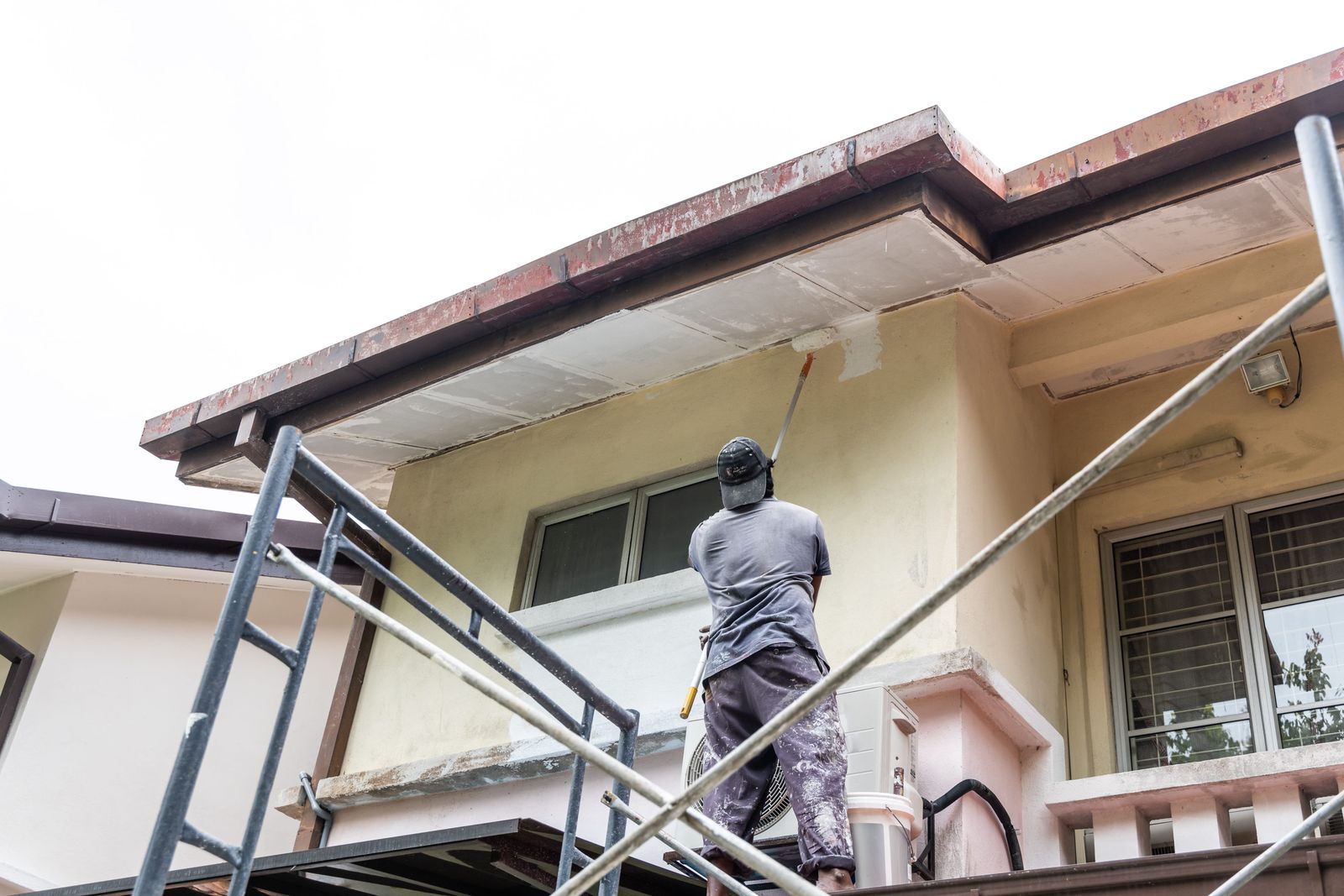
The practical consequence is that a Gauteng exterior repaint almost always needs a genuine preparation phase before any finish coat: high-pressure cleaning to remove chalking and algae, crack repair, treatment of any damp, and a primer matched to the substrate. On most exterior repaints that preparation is 40–50% of the labour. It is also completely invisible in the finished result, which is exactly why it is the first thing cut from a cheap quote.
What a proper quote must include
A quote worth comparing spells out all of the following. If any line is missing, ask about it before you compare prices.
- Measured area, stated in square metres, so you can check all three quotes are pricing the same job
- Surface preparation — cleaning, scraping, sanding, crack repair, filling, itemised rather than bundled
- The primer, named by product, and why that primer suits your substrate
- Number of finish coats, stated separately from the primer
- The topcoat product and range, not just the brand name
- Protection — drop sheets, masking, covering of furniture, plants and paving
- Access equipment where the job needs it, and who supplies it
- Site cleanup and removal of waste
- Public liability insurance, and who carries it
- A written workmanship guarantee, with a stated period and what it covers
- Payment terms — deposit, progress payments, and a final payment held until snagging is signed off
The seven things that move the price
1. The condition of the surface
This is the single biggest variable, and it is why on-site assessment matters. Sound walls need washing and two coats. Walls with flaking paint, plaster cracks, chalking or damp need days of remedial work before painting begins. On a bad exterior the preparation can genuinely exceed the painting.
2. How many coats the colour change needs
Going from a dark colour to a light one, or covering a strong accent colour, often needs an extra coat. So does painting over bare or newly repaired plaster, which absorbs unevenly.
3. Access and height
Double storey, steep driveways, tight side passages, high gables and roofs over conservatories all add time and equipment. A wall you can reach from a ladder is a fundamentally cheaper wall than one that needs a tower.
4. Paint quality
Budget paint runs around R160–R240 per 5L, mid-range around R280–R420, and premium exterior systems R420–R650 and up. On a full exterior that difference compounds into real money — but so does the lifespan. Our guide to paint brands in South Africa covers where the premium is worth paying and where it is not.
5. Detail work
Burglar bars, palisade fencing, trellis, window frames, shutters and pergolas are slow, fiddly and priced by time rather than by area. A house with a lot of steelwork can cost significantly more than its wall area suggests.
6. Damp and waterproofing
If there is rising damp, a leaking parapet or a failed roof junction, painting over it wastes your money — the coating will blister or peel within a season. That has to be diagnosed and fixed first. Our guide to telling the three types of damp apart explains how to work out which problem you actually have.
7. Timing
May to September is the settled painting season on the Highveld, and demand peaks accordingly. Work booked in the shoulder months is often easier to schedule. Our guide to the best time to paint in Gauteng sets out the reasoning month by month.
A worked example, line by line
Here is how a realistic exterior repaint on a single-storey three-bedroom house breaks down. The house has sound plaster with some hairline crazing, moderate chalking on the north and west elevations, and steel window frames.
| Item | Share of job | What it covers |
|---|---|---|
| Preparation | ~40% | Pressure clean, scrape, sand, fill crazing, treat chalking |
| Primer | ~10% | Bonding liquid on chalked areas, plaster primer on repairs |
| Two finish coats | ~30% | Cutting in, rolling, second coat |
| Detail work | ~12% | Window frames, burglar bars, fascia, downpipes |
| Protection & cleanup | ~8% | Sheeting, masking, plant and paving protection, waste removal |
Notice that actually applying the colour is under a third of the work. When a quote comes in dramatically below the others, this table is where the difference has been found — almost always in the first two rows.
Six mistakes that cost homeowners money
Comparing totals instead of specifications
Three quotes with three different prices are not three prices for the same job until you have checked they are pricing the same area, the same preparation and the same products. Line them up before you compare rands.
Accepting "good quality paint" as a specification
Every contractor says this. Ask for the product range in writing. It is the difference between a coating that holds its colour through five Highveld summers and one that chalks by the second.
Painting over an unresolved damp problem
Paint is a thin film. It cannot cure over trapped moisture and it will not stop water moving through masonry. Fixing the cause first is cheaper than painting twice.
Painting new plaster too early
Plascon's own technical data sheet for plaster primer specifies that new plaster should be allowed to dry for at least 28 days before priming.[4] Dulux Trade approaches it differently, setting a moisture-content threshold instead — its moisture-tolerant plaster primer tolerates up to 30% moisture, while standard topcoats are described as suited only to walls at 12% or below.[5] Either way, painting fresh plaster on a builder's schedule rather than the plaster's schedule is a well-known route to blistering and discolouration.
Paying too much upfront
A deposit to cover materials is normal. Paying most of the contract before work starts removes your only real leverage if the job stalls. Hold a meaningful final payment until snagging is complete.
Skipping the walk-through
Do a proper snag walk with the contractor before final payment, in daylight, looking at the surfaces from an angle. Touch-ups are quick and cheap while the team and the tinted paint are still on site, and expensive to arrange afterwards.
How to compare three quotes properly
Get three, and put them side by side on the same terms. Ask each of these:
- Are all three quoting the same measured area? If one is materially smaller, ask what was excluded.
- Does each one name the primer and the finish product?
- How many finish coats, counted separately from the primer?
- Is preparation itemised, or hidden inside a single line?
- Is there a written guarantee, and what specifically does it cover?
- Is the contractor insured, and will they show you the certificate?
- What happens if the plaster turns out to be worse than it looked once work starts?
That last question is the most revealing one you can ask. A contractor who has thought about the job will have a clear answer — usually that they will stop, show you, and quote the additional remedial work before proceeding. A vague answer tells you the quote was a guess.
Checking a contractor is legitimate
South Africa does have relevant industry infrastructure, and it is worth knowing what actually exists versus what contractors sometimes imply.
SANS 10305 is the South African National Standard covering painting of buildings. It runs to six parts, published in 2012, covering paint and paint selection, paint application and defects, paint types, painting of walls, ceilings and cladding, painting of roofs and steel structures, and painting of wood.[6] A contractor who works to it is working to a real, published national standard rather than to habit.
SAPMA, the South African Paint Manufacturers' Association, describes itself as the trade association that regulates more than 90% of all paint manufactured in South Africa.[7] Relevantly for homeowners, SAPMA runs a Guarantee Verification Scheme covering contractor members, which is designed to audit and verify them, and which separates the product guarantee from the manufacturer and the service guarantee from the contractor of record. SAPMA also reports a memorandum of understanding with the Consumer Goods and Services Ombud. Worth knowing: SAPMA is a trade association, not a standards-setting body — its Code of Conduct requires members to comply with applicable standards rather than writing them.
On older homes, there is a regulatory point worth being aware of. In May 2024 the Department of Health published Regulations Relating to Lead in Paint or Coating Materials under the Hazardous Substances Act, 1973, limiting total lead in paint to 90 ppm, with the substantive provisions taking effect a year after publication.[8] That governs paint sold today. If your home is older and you are stripping or sanding original coatings, treat the dust as something to contain and avoid rather than something to sweep up casually.
Frequently asked questions
How much does it cost to paint a 3-bedroom house in Gauteng?
Published price guides put a 3-bedroom interior repaint at roughly R14,000 to R26,000 and an exterior repaint at roughly R16,000 to R30,000, including labour and materials. The final figure depends mainly on surface condition, the paint system specified, and whether the house is single or double storey.
Is painting priced per square metre or per room?
Most painting in South Africa is quoted per square metre of surface area — roughly R40 to R95 per m² for labour only, or R100 to R250 per m² for labour plus materials. Small jobs such as a single room or one ceiling are sometimes quoted as a fixed price instead.
Why are painting quotes so different from each other?
The biggest cause is surface preparation. A quote assuming sound walls and two coats will always be cheaper than one including pressure cleaning, crack repair, damp treatment and priming. The second and third causes are the paint system specified and whether access equipment is required.
How long does a professional repaint last in Gauteng?
It depends far more on preparation and product than on brand. Under Highveld UV, a properly prepared and correctly primed exterior in a quality system will substantially outlast a premium paint applied over a chalking, unprimed wall. Anyone offering a guaranteed number of years without having seen your walls is guessing.
Do I need to move out while my house is painted?
Almost never for exterior work. For interiors, most households stay put and work room by room, moving furniture to the centre and covering it. Modern water-based acrylics have far less odour than older solvent-based products, though ventilation still matters, particularly in winter when houses are closed up.
Should I supply the paint myself?
You can, and labour-only rates exist for exactly this. In practice most homeowners come out even or slightly behind, because contractors buy at trade prices and because if you supply the paint, product-related failures become your problem rather than a shared one. If you do supply it, buy what the contractor specifies rather than substituting.
Conclusion
The honest summary is that painting is priced on condition, not on square metres alone, and that the ranges in this guide are a sanity check rather than a quote. If your walls are sound, expect to land toward the lower end. If they are chalking, cracked or damp, expect the preparation to carry the cost — and be glad it does, because the alternative is paying to paint the same wall twice.
When you compare quotes, compare the specification rather than the total. Ask what primer, how many finish coats, what happens if the plaster is worse than it looks, and whether the contractor carries public liability cover. The quote that answers those questions clearly is usually the one that has actually been thought about.
Sources & references
- Wright CY et al., Solar Ultraviolet Radiation Exposure in South Africa, Int. J. Environ. Res. Public Health 14(11):1384, 2017 — co-authored with the South African Weather Service; mean UV index for Pretoria and summer peak — Europe PMC full text
- World Meteorological Organization, World Weather Information Service — Johannesburg climate normals supplied by the South African Weather Service (1961–1990): annual rainfall and monthly distribution — worldweather.wmo.int
- Kahraman A et al., Hail in South Africa, Natural Hazards and Earth System Sciences 23, 1549–1565, 2023 — hail concentration along the Highveld and seasonal timing — nhess.copernicus.org
- Plascon, Plaster Primer technical data sheet (UC 56) — minimum 28-day drying period for new plaster before priming — plascon.co.za
- Dulux Trade, Plaster Primer Moisture Tolerant technical data sheet — substrate moisture thresholds of 30% and 12% — Dulux Trade TDS
- South African Bureau of Standards, SANS 10305:2012 — Painting of buildings, Parts 1–6 — store.sabs.co.za
- South African Paint Manufacturers' Association (SAPMA) — role in the industry and the Guarantee Verification Scheme — sapma.org.za
- Department of Health, Regulations Relating to Lead in Paint or Coating Materials, Notice 4832, Government Gazette 50665, 17 May 2024, under the Hazardous Substances Act 15 of 1973 — gov.za
Prices quoted in this guide are published market ranges from South African quoting platforms, not regulated figures. They are included so you can sanity-check a quote, and will vary by property, surface condition and specification.